
Overview of the Cashew Tree
I. HISTORY AND ORIGIN OF THE CASHEW TREE
The cashew tree, scientifically known as Anacardium occidentale L., belongs to the mango family and is also known as the peach nut. It originated in Brazil, in the tropics of South America, and gradually spread to other continents, including Africa, Asia, and Australia. Today, cashew trees are grown all over the world, and they are capable of withstanding diverse and harsh climatic conditions. However, cashews thrive in a tropical climate with a distinct dry season. According to the Food and Agriculture Organization (FAO), there are currently over 32 countries producing commercial cashews, but they are best suited for cultivation in countries with tropical and subtropical climates. The top ten cashew-growing countries in the world are India, Vietnam, Brazil, Nigeria, Tanzania, Indonesia, Guinea-Bissau, Côte d’Ivoire, Mozambique, and Benin. Cashews have become a vital crop in several tropical and subtropical countries and hold an essential position in the agricultural market.
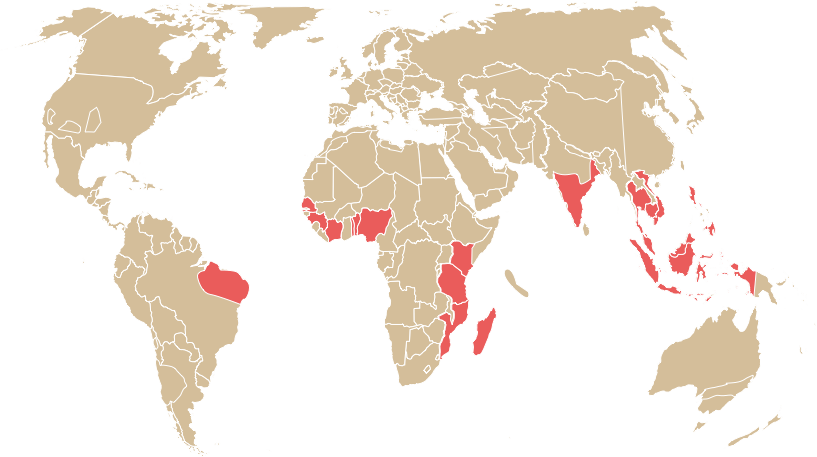
Major Cashew Producing Countries
II. CHARACTERISTICS OF CASHEWS
After pollination, cashews grow rapidly, and the petioles swell into a fruit, which is a false fruit. After 60 days, the ripe fruit will turn red or yellow, depending on the variety. The fruit is usually found in clusters at the tips of the branches.
The cashew nut, which is the true fruit, has a kidney shape and is green when fresh. It turns brown when it dries and protrudes from the top of the false fruit, resembling a peach with a seed sticking out. This is why the cashew tree is also known as the cashew tree.
Cashew nuts consist of three parts:
a) The shell is usually 0.4 cm thick and accounts for 70% of the weight of the seed. It has three layers: an outer layer that is long and smooth, a middle layer that is porous like a sponge and contains a lot of cashew shell oil, and an inner layer that is very hard.
b) The silk shell surrounds the kernel and accounts for 5% of the weight of the seed.
c) The kernel is the innermost part.
Cashew kernels have a high protein content with all essential amino acids, making them comparable to meat, eggs, and milk. They are considered a food with high nutritional value and are a major ingredient in commercial exchanges in the market. Cashews are highly profitable and play a significant role in the agricultural market, annually bringing exporting countries a considerable amount of foreign currency.
Cashews are rich in essential nutrients, making them an ideal vegetarian food and a valuable medicine for several diseases. They are also a high-fat food with 0% cholesterol, making them suitable for dieters. Currently, developed countries worldwide are promoting the increased use of cashew kernels. The countries that import and consume the most cashews in the world are the United States, which accounts for nearly two-thirds of the world’s cashew production, and countries belonging to the former Soviet Union, the European Union (EU), and Japan.
III. OVERVIEW OF THE CASHEW PROCESSING INDUSTRY
CASHEW PRODUCTION SITUATION
1.1. Global situation
Cashew trees thrive in countries located in the sub-equatorial region where the temperature and humidity are high. India has one of the largest cashew acreages in the world and leads in terms of raw cashew production and processing kernels. It is estimated that the world’s total raw cashew production ranges between 1,575,000 to 1,600,000 tons, including 400,000 to 500,000 tons from India, accounting for about 25-30% of the total output. Other major producers include Brazil, Vietnam, and African countries such as Côte d’Ivoire and Tanzania. African countries contribute about 500,000 tons of raw cashews to the world’s total production annually.
1.2. In India
Cashew trees are widely grown in the states of Maharashtra, Andhra Pradesh, Orissa, Kerala, Tamil Nadu, Karnataka, Goa, and West Bengal. Besides these traditional cashew-growing states, cashews are also grown in other Indian states such as Gujarat and Assam, where cashew acreage has recently experienced a significant increase.
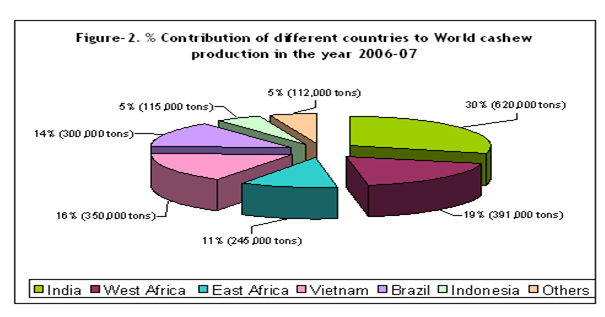
The world's leading cashew-processing countries
Cashew-producing countries, such as India, Brazil, and Vietnam, remain the largest cashew-processing countries in the world. Historically, African countries have processed very little of their raw cashew production and have exported more than 90% of it to India. However, with the development of African countries, there are increasing efforts to boost their processing capacity. India is one of the leading countries in terms of processing output, with an annual capacity of more than 950,000 tons of cashews. However, it can only meet about half of its own raw material needs and has to import raw cashew nuts from African countries, and previously from Vietnam. Vietnam has a processing capacity of 400,000 tons of raw cashew nuts per year, while Brazil can only process about 250,000 tons.
1.3. Supply and Demand in the Cashew Nut Processing Industry
The top cashew-producing countries, namely India, Brazil, and Vietnam, account for about 70% of the world's total cashew production. North America is the largest consumer of cashew kernels, accounting for about 50% of the world's total consumption, followed by the European Union (EU) at 29%, and Asian countries, mainly India and China, at 21%.
2. THE SITUATION IN VIETNAM
Cashew trees have been an important part of Vietnam's forestry sector since the 1980s, and by 1990, they had become a key export perennial industrial crop. Cashews can grow in a variety of soils and regions, including the Southeast, the lowlands of the Central Highlands, the South Central Coast, and some highlands in the Mekong Delta. These multi-purpose trees contribute to economic development, soil protection, environmental protection, and poverty alleviation, due to their fast growth, strong roots, and wide canopy that protects the soil and limits erosion.
Vietnam has made significant progress in exporting nuts in recent years, with cashews being a key contributor to this growth. The country has strongly shifted from being a producer of raw nuts to an exporter of processed cashews, and is gaining market share from its main competitors, India and Brazil. Cashew nut export value in Vietnam was $654 million in 2007, making it one of the most important agricultural products after rice, coffee, and rubber. In 2008, the export value reached $920 million, and in 2009, it earned $847 million. According to the Vietnam Customs Department, in the first six months of 2010, Vietnam exported 80,000 tons of cashew nuts worth $425 million, up 26% in value and 6% in quantity compared to the previous year. With a world market share of 25%, Vietnam became the world's largest cashew nut exporter in early 2007.
As of 2013, Vietnam had 310,000 hectares of cashew trees, with 60.8% of the acreage concentrated and 39.2% dispersed. The average yield was 9.1 quintals per hectare, and the output was 285,000 tons of seeds. Export turnover reached $1.654 billion (including cashew nuts, cashew nut shell oil, and products processed from cashews) in 95 countries and territories. The United States was the largest market, accounting for approximately 35% of the market share, followed by China with 20%, the EU with 20%, and other countries with 25%. There were 330 export units, mainly small and medium enterprises, with 80% of enterprises having an export turnover of under $5 million per year. Domestic consumption accounted for a very low rate of about 4%.
Cashew nuts are one of Vietnam's agricultural products that have reached over $1 billion in exports, increasing both in volume and value compared to the previous year, according to statistics.
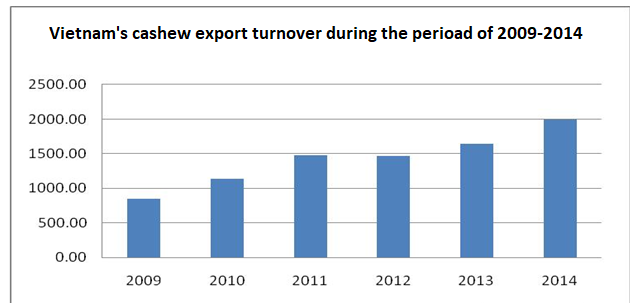
From 2009 to 2013, Vietnam's cashew export turnover grew from $846.68 million to $1.64 billion. In 2014, Vietnam exported 302,900 tons of cashew nuts worth nearly $2 billion, which represents a 16.2% increase in volume and a 21.4% increase in value compared to 2013.
Currently, Vietnam exports cashew products to 26 markets worldwide, with the United States, China, the Netherlands, and Australia being the largest markets with export turnovers exceeding $100 million, accounting for 64.53% of Vietnam's total cashew nut export turnover in 2014. The United States is the biggest market with a turnover of $635.94 million, representing 31.87% of Vietnam's cashew nut exports and an increase of 18.28% over the same period in 2013. China is the second-largest market with a turnover of $313.30 million, which is up 4.52%. The Netherlands comes in third with a turnover of $228.95 million, accounting for 11.47% of Vietnam's total cashew nut export turnover and an increase of 42.95% compared to the previous year.
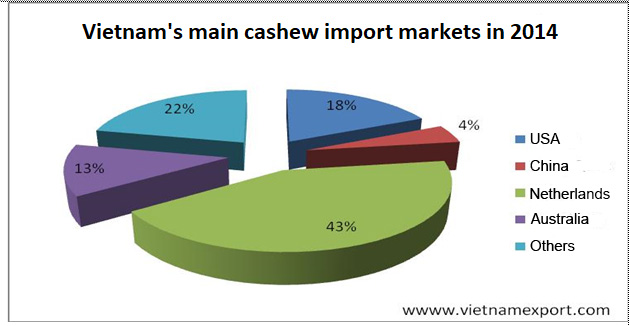
The majority of markets saw growth in Vietnam's cashew exports in 2014, with some markets experiencing particularly high growth rates. Japan had the highest growth rate, up 207.3%, followed by Belgium at 108.74%, and France at 83.61%. However, Vietnam's cashew exports to India decreased significantly by 84.79% compared to 2013. Norway and Russia also saw slight decreases in cashew imports from Vietnam, with decreases of -4.82% and -2.67%, respectively.